

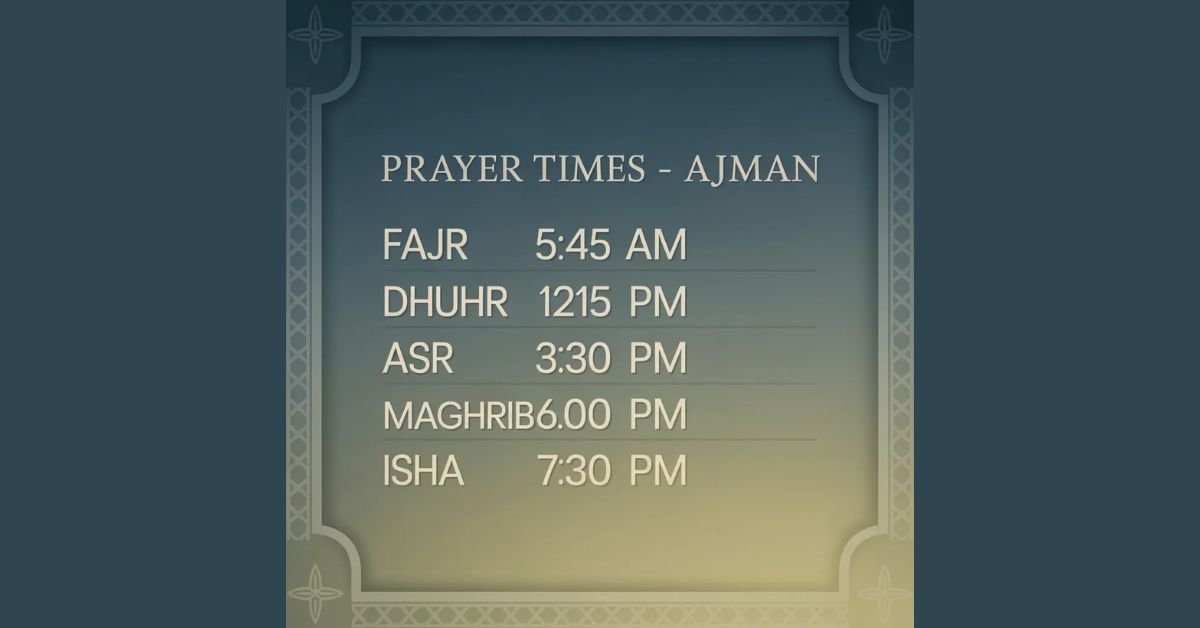
Have you ever missed a prayer simply because you didn’t know the exact time? For millions of Muslims living and working in Ajman, UAE, knowing the precise Namaz Time Ajman. Every day is not just a spiritual necessity — it is a daily commitment to one of Islam’s most sacred pillars. Whether you are a resident, an expat, or a visitor in this vibrant emirate, staying informed about today’s full prayer schedule is essential to maintaining your connection with Allah (SWT).
This article provides today’s complete and accurate Namaz Time Ajman. Explains how prayer times are calculated, and offers practical guidance to help you. Observe every prayer on time, every single day.
Why Accurate Namaz Times in Ajman Matter Every Day
Prayer times in Islam are not fixed to a clock — they shift daily based on the movement of the sun. This means the Fajr time you followed last week may be slightly different this week. Prayer times in Ajman vary slightly every day depending on the movement of the sun. Making it important to check the schedule daily for updated times. For the hardworking Muslim community of Ajman. Which includes a significant population of South Asian expats for whom the word “Namaz” is more familiar than “Salah,” having a reliable daily prayer timetable is a genuine need.
Ajman, the smallest of the seven emirates of the UAE, operates on UTC+4 and does not observe daylight saving time. The prayer times in Ajman are calculated using the Mecca – Umm al-Qura method. And the Standard (Shafi, Hanbali, Maliki) juristic method is used for calculating the Asr prayer time. This official calculation method ensures consistency with UAE government standards and aligns. With the General Authority of Islamic Affairs and Endowments.
Today’s Full Namaz Schedule for Ajman, UAE – April 12, 2026
Based on the most current and reliable sources available for Ajman today, here is the complete prayer timetable:
Fajr (Pre-Dawn Prayer): 4:55 AM Sunrise: 6:01 AM Dhuhr (Midday Prayer): 12:24 PM Asr (Afternoon Prayer): 3:52 PM Maghrib (Sunset Prayer): 6:33 PM Isha (Night Prayer): 8:03 PM
Today’s prayer times in Ajman include Fajr at 4:55 AM, Dhuhr at 12:24 PM, Asr at 3:52 PM, Maghrib at 6:33 PM, and Isha at 8:03 PM. These timings follow the officially approved calculation method used across the UAE. And are suitable for all Muslims observing the five daily obligatory prayers in Ajman city.
Understanding Each of the Five Daily Prayers
Islam mandates five obligatory prayers each day. And each one holds a specific place in the daily rhythm of a Muslim’s life. Salah is obligatory for adult Muslims, and prayer times are set according to the movement of the sun and performed five times a day. Understanding the meaning and timing of each prayer deepens a worshipper’s awareness and devotion.
Fajr is the first prayer of the day, offered before sunrise while the sky is still dark. It consists of two obligatory Rakats and sets the spiritual tone for the entire day ahead. Fajr salah should be performed in the last part of the night and before sunrise and consists of two obligatory rakats, known as Fard. Waking up for Fajr requires discipline, but it is widely regarded among scholars as one of the most spiritually. Rewarding acts in a Muslim’s day.
Dhuhr is the midday prayer offered after the sun has passed its highest point in the sky. Dhuhr salah is the second prayer of the day and is offered at noon, comprising four obligatory rakats. For working professionals in Ajman, particularly those in offices or labour sectors. Taking a short break during lunch to observe Dhuhr is both spiritually fulfilling and practically manageable.
Asr is the afternoon prayer and is a critical prayer that the Quran specifically references. It is performed in the mid-afternoon after the shadow of any object becomes equal to its actual height. Asr salah is performed in the afternoon after the Dhuhr prayer. Missing Asr is strongly discouraged in Islamic teaching. And believers in Ajman are urged to schedule their afternoons around this prayer.
Maghrib is the sunset prayer offered shortly after the sun dips below the horizon. It is one of the shorter prayers, consisting of three Rakats, yet carries immense significance as it marks the transition from day to night. In Ajman today, Maghrib is at 6:33 PM, which also corresponds to Iftar time for those observing voluntary fasts.
Isha is the final obligatory prayer of the day and is offered at night. It closes the day’s worship cycle and offers a moment of reflection and gratitude before sleep. In Ajman, the Isha Azan will call at 8:04 PM, and the allotted time for Isha prayer will expire at Fajr the following morning.
How Namaz Times Are Calculated in Ajman
The science behind prayer time calculation is both astronomical and theological. The Mecca – Umm al-Qura method is the official method used in Saudi Arabia. And is based on the Umm al-Qura calendar of Mecca. In Ajman, this same method is adopted under the supervision of the UAE’s General Authority of Islamic Affairs. Ensuring that all mosques across the emirate call the Adhan at the correct and standardized time. The geographic coordinates of Ajman — latitude 25.4052° N and longitude 55.5136° E — are used to calculate the precise solar angles that determine the start of each prayer window.
Prayer times advance and recede across the calendar year. During summer months, Fajr arrives earlier and Isha stretches later into the night. In spring and autumn, the distribution becomes more balanced. This is why residents of Ajman should never rely on memorized times but instead consult a daily updated timetable.
The Role of the Adhan in Ajman’s Daily Prayer Life
The public call to prayer is called the Adhan, delivered from the masjid by a muezzin — the masjid’s designated caller of prayer. Across Ajman’s mosques, the Adhan rings out five times a day. Carrying the familiar words “Allahu Akbar” across the neighbourhoods, streets, and markets of the city. For many residents, particularly the large South Asian Muslim community. Hearing the Adhan is a deeply emotional and identity-affirming experience — a reminder that no matter how busy the world becomes, the call to worship always takes priority.
It is common to hear the call to prayer in public in countries with significant Muslim populations. And the Adhan is usually recited from the minaret of masjids facing toward the Holy Kaaba in Makkah. In Ajman, mosques are strategically distributed throughout the city’s residential and commercial zones. Ensuring that no believer is ever too far from a place of congregation.
Tips for Never Missing a Namaz in Ajman
Staying consistent with five daily prayers in a busy city like Ajman requires planning, intention, and the right tools. Here are some practical strategies.
Set alarms for each prayer time. With today’s schedule in hand — Fajr 4:55 AM, Dhuhr 12:24 PM, Asr 3:52 PM, Maghrib 6:33 PM, and Isha 8:03 PM — setting five daily reminders on your phone takes less than two minutes and removes every excuse for missing Salah.
Use a trusted prayer time app. Apps like Athan provide daily Namaz notifications and allow users to log their prayer history, making it easy to track consistency over time. These digital tools are especially useful for expats who have recently moved to Ajman and are not yet familiar with local mosque schedules.
Identify the nearest mosque to your home or workplace. Many Muslims pray in congregation in a masjid, as praying together helps Muslims realize that all humanity is one and all are equal under the eyes of God. Ajman has a dense network of mosques, many within walking distance of major residential areas.
Plan meetings and appointments around prayer windows. This is a normal and respected practice in the UAE, where Islamic values are embedded in the culture of the workplace and public life.
Monthly and Annual Prayer Timetable for Ajman
For those who prefer planning ahead, a full monthly or annual Namaz timetable for Ajman is essential. You can print the Islamic Calendar 2026 and Namaz timetable of prayer times in Ajman for the whole year, and the prayer timings schedule is updated automatically to provide the most authentic timings. Whether you want to plan a week’s schedule or track prayer times throughout Ramadan, a monthly timetable removes uncertainty and builds routine.
The shift in prayer times across April 2026 in Ajman is gradual but noticeable. Fajr progressively moves earlier as spring advances toward summer, while Maghrib pushes later into the evening as daylight hours increase. Staying aware of these seasonal changes is part of a mindful Muslim’s spiritual practice.
Conclusion: Stay Punctual, Stay Connected to Your Faith
In a fast-paced city like Ajman, where commerce, construction, and daily life move quickly, Namaz remains the anchor that keeps a Muslim’s day spiritually grounded. Today’s full prayer schedule — Fajr 4:55 AM, Dhuhr 12:24 PM, Asr 3:52 PM, Maghrib 6:33 PM, and Isha 8:03 PM — gives every Muslim in Ajman everything they need to observe their obligations accurately and confidently. Make it a daily habit to check the updated Namaz times, set your reminders, and ensure that no worldly distraction pulls you away from the most important appointments of your day — the five conversations you have with your Creator.
