

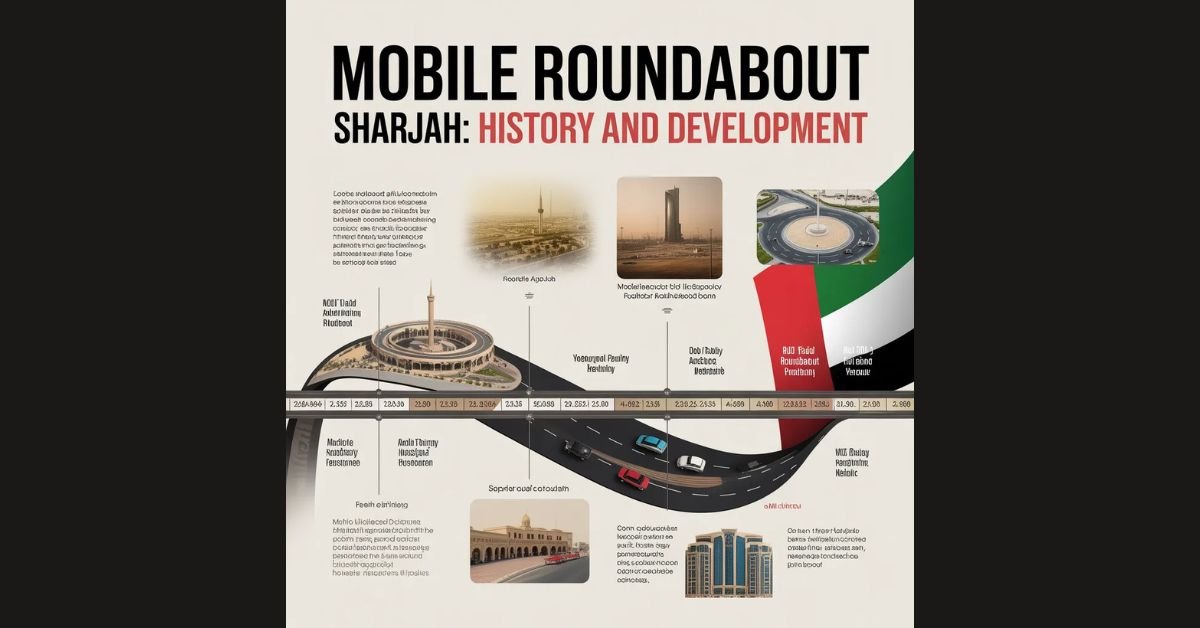
The development of the whole city is portrayed by a lone traffic landmark? The Mobile Roundabout Sharjah, it is an enclosure of the urban growth, cultural identity, and development of infrastructure. The Mobile Roundabout is associated with its unique center and strategic location and has been the witness of the development of Sharjah that started as a small trading center and evolved into a modern metropolis. This paper will examine the history and construction of the Mobile Roundabout in Sharjah, including its construction, design, its importance in traffic and its impact on urban planning of the city. It will help the readers understand how this roundabout reflects the economic development, population increase, and sustainable mobility vision of Sharjah.
The Urban Context and Emerging Road Development of Sharjah
It is imperative to consider a wider context of Sharjah development before comprehending what the Mobile Roundabout is. The economic change in Sharjah was rapid in the 1960s and 1970s due to trade, port activity, and population growth. The roads at this time were basically constructed to be able to provide linkage between residential areas and ports, markets and administration. Traffic was not particularly large, intersections were commonly quite basic crossroads or that type of tiny circle junction.
The population of Sharjah continued to expand with the oil revenues and the commerce with various regions. Government planning agencies started thinking about planned road networks that were capable of supporting increased number of vehicles. In the late 1970s, there was a realization that organized roundabouts were necessary because they provided a smoother movement of traffic, without a high degree of signal system.
The Mobile Roundabout Origins
The Mobile Roundabout was made in a time when Sharjah emphasized more on symbolic building constructions as well as realistic road solutions. It is named so because it contains a huge mobile phone monument at the center that represented the improvement of communication and technological development at the end of the twentieth century. Telecommunications in the UAE were growing exponentially at the same time, and the monument was a hope that there was more connection and modernization.
Firstly, the roundabout was a linking place between developing business communities and residential communities. It has been well placed to give a balance in traffic distribution, minimize traffic jams and create a landmark against which it can be navigated. The designs were made simple in the early ones, and it included broad circular lanes and little ornamentation around the central sculpture.
Design and Symbology in Architecture
The architectural nature of the Mobile Roundabout also makes it unique compared to other normal traffic circles. The huge monument in the form of a vintage mobile phone turned out to be an immediate visual point of reference. This design decision was in line with the tradition of developing functional infrastructure in Sharjah with cultural or symbolic art.
Urban design wise, the roundabout was based on proportional geometry so that it could be seen and be safe. The landscaping was introduced progressively around the monument, with shrubs of low height and palm trees, which did not interfere with the sightline of the drivers. In the course of time lighting systems were improved to emphasize the monument during the night which strengthens its position as a landmark in the city.
Strategic Importance and Traffic Function
The Mobile Roundabout is playing a vital role in the internal mobility of Sharjah in a functional manner. It connects major arterial roads which interconnect the business areas, residential areas and educational establishments. With the dramatic growth in the number of vehicles in Sharjah in the 1990s and early 2000s, there was also a corresponding increase in traffic crossing the roundabout.
Transport planning estimates show that the number of vehicles owned by people in Sharjah had increased by over 300 percent over the period between 1995 and 2015. This development put a strain on the available intersections and the Mobile Roundabout was no exception. The response was expansion of approach roads by authorities, better lane markings, and entry and exit angles to ensure efficiency in traffic movement.
Evolution Through Infrastructure Upgrades
The Mobile Roundabout did not cease being developed at the time of its initial construction. The roundabout was upgraded by a number of upgrades as Sharjah became more urbanized. These were safety, capacity, and integration with the adjacent road systems.
In the beginning of 2000s, road research has shown that there was a peak congestion during the peak hours as more people moved to and out of the city. To counter this, the roads were improved and made by adding better drainage systems and standardizing the road signs. Subsequently, smart traffic surveillance gadgets were implemented in the entire Sharjah, allowing the authorities to study the flow patterns and make decisions based on data to manage junctions.
Part in Commercial and Economic Development
The neighborhoods around the Mobile Roundabout slowly turned into operational business territories. High visibility and easy accessibility were an advantage to retail outlets, offices, and service centers. This change is a larger pattern in Sharjah where investments in infrastructure are directly related to economic activity.
Urban economists observe that there is usually an increase in commercial value of properties located close to major roundabouts and arterial roads because of exposure to traffic. In Sharjah, commercial rentals in the desirable areas have grown by an estimated 15 to 20 percent in the past decade, 2010 to 2020, which demonstrates the economic role of the strategic transport locations such as the Mobile Roundabout.
Cultural Identity and Local Recognition
The Mobile Roundabout has a cultural value to the residents beyond the traffic and trade. It acts as a guiding landmark in the directions and a representation of a certain period in the evolution of Sharjah. Most of the long time residents relate the roundabout to the period when the city was transformed into a modern urban atmosphere.
Sharjah is a city that has maintained cultural identity and modernization. Some of the cities do demolish old structures but Sharjah tends to refurbish and incorporate them in new planning. This philosophy is evident in the fact that the Mobile Roundabout monument still exists, and the continuity between the past and the present.
Liaison with Contemporary City Planning
The last few years have seen Sharjah have an urban planning approach which focuses on sustainability, transportation, and minimizing congestion. This vision has been incorporated in the Mobile Roundabout by way of enhanced pedestrian crossing in the area, enhanced transport routing and the synchronization of signalized crossing.
Adaptive junction designs are becoming of interest to urban planners who prefer evolving designs with the traffic demand. Whereas there are roundabouts that are transformed into signalized crossings, other ones are maintained but restructured. The Mobile Roundabout is a trade-off between the circular design and modern principles of traffic control.
Traffic Safety and Data-Driven Improvements
The issue of traffic safety has played a very significant role in the development of the roundabout. Research has always indicated that roundabouts are able to minimize serious accidents by up to 70 percent as opposed to crossroads with conventional intersections. According to the accident statistics in Sharjah in the last ten years, the serious collisions in the roundabouts that were upgraded are gradually decreasing even in the regions around the Mobile Roundabout.
Better navigation has been made possible by improvements like better lane discipline, road reflective marking, and increased lighting during night. Such actions would be in line with the overall road safety initiatives in Sharjah in an attempt to mitigate traffic-related injuries.
Mobile Roundabout in the Digital Age
The work of such landmarks as the Mobile Roundabout is also in constant development as Sharjah adopts smart city technologies. The roundabout has become one of the major reference points when using digital mapping, navigation applications, and traffic sensors. Traffic information will also assist drivers to make the best decisions by taking up the best routes to follow, thereby minimizing congestion at the busiest periods.
The symbolic mobile phone monument acquires new meaning in this digital age, as connectivity to the world is not only relevant in the communication process, but also in smart transport systems. This correspondence of symbol and usage accentuates considerate urban symbolism.
Difficulties and Future Opportunities
The Mobile Roundabout has its share of challenges despite its success, as it is typical of growing cities. Growing volumes of traffic, shifting trends in mobility and the emergence of ride services necessitate continuous measures. Urban planners have to make a decision on how to continue to expand it, partially signalize or use some other solutions to route planning needs in the future.
The population of Sharjah is also estimated to increase continuously, and the urban transport demand is also expected to increase. It is probable that the Mobile Roundabout will not be designed out of the box but will get new features as an expansion to maintain its status as a landmark and be efficient.
Conclusion
The Sharjah Mobile Roundabout and its history depict the development of the urban growth and its reflection by the infrastructure. Since its establishment as an effective cross-road with decorative design to its present-day in a contemporary transport network, the roundabout is a tribute to the aggressive development philosophy in Sharjah. Through cultural identity, economic utility, and adaptive planning, the Mobile Roundabout is a stable part of the city landscape and a vivid illustration of how carefully planned infrastructure contributes to the future success of the city.
