

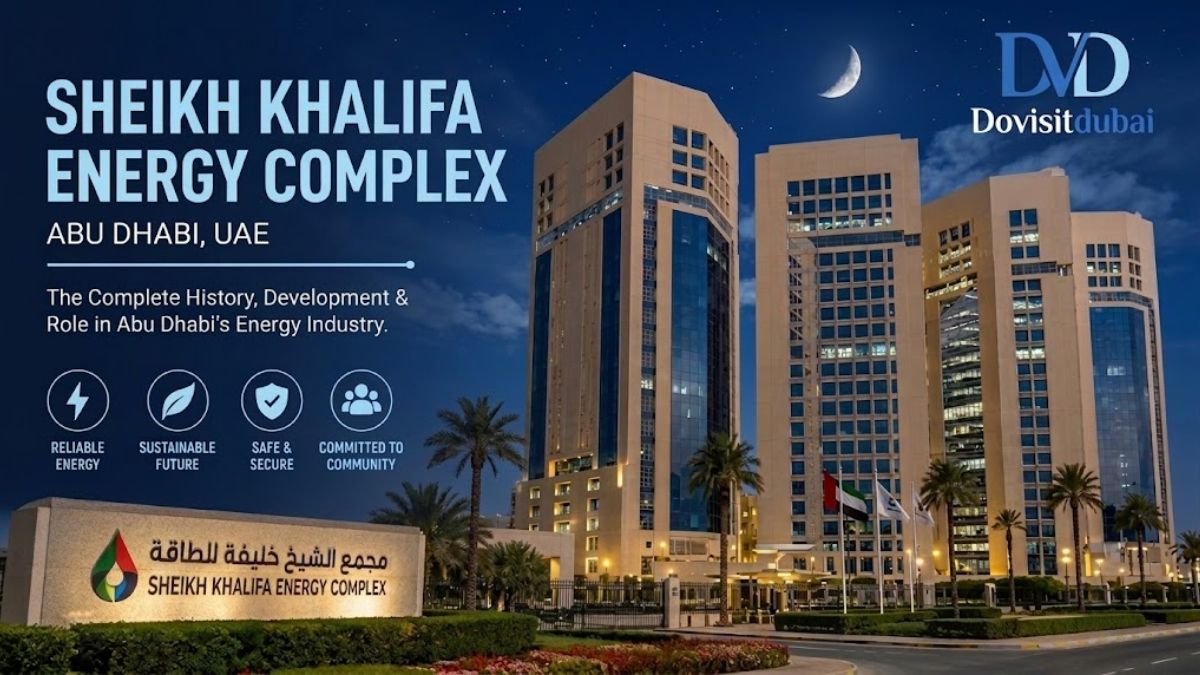
The Sheikh Khalifa Energy Complex is one of Abu Dhabi’s most important corporate landmarks. It serves as the operational nerve center for several major companies inside the ADNOC Group.
If you have ever searched for details on this complex, you already know that clear information is hard to find. This guide breaks down its history, development, structure, and significance in simple terms.
We will also clear up common confusion with the similarly named Sheikh Khalifa Hospital, since both share the respected name of the late UAE President.
What Is the Sheikh Khalifa Energy Complex?
The Sheikh Khalifa Energy Complex (SKEC) is a large office and business park located on Khalifa Bin Zayed The First Street in the Al Danah district of Abu Dhabi Island. It sits close to the Corniche, placing it in the heart of the city’s commercial core.
Unlike a power plant, SKEC is fundamentally a corporate headquarters hub. It was purpose-built to house the administrative offices of Abu Dhabi’s largest energy companies under one roof.
The complex primarily hosts the headquarters of:
- TAKREER (Abu Dhabi Oil Refining Company)
- Borouge (petrochemicals joint venture)
- ZADCO (Zakum Development Company)
- GASCO (Abu Dhabi Gas Industries Limited)
These entities operate as key subsidiaries and joint ventures under the wider ADNOC (Abu Dhabi National Oil Company) umbrella, which controls the emirate’s vast oil and gas reserves.
The History Behind Sheikh Khalifa Energy Complex
Understanding the history of SKEC means understanding Abu Dhabi’s rapid industrial expansion. As the emirate’s energy sector grew through the late 20th and early 21st centuries, its component companies needed dedicated, secure office space near the seat of government.
The complex was developed as a single, purpose-built precinct rather than a repurposed commercial building. This decision reflected a broader UAE strategy: energy companies require specialized security, coordination, and compliance infrastructure that standard office towers cannot easily provide.
A Phased Construction Approach
One of the most notable historical facts about SKEC is that it was not built all at once. Records indicate the complex expanded in stages, with two of its taller towers constructed several years after the original core towers were completed.
This phased approach is common in large-scale Gulf developments, where:
- An initial core structure is completed to meet immediate operational needs.
- Additional towers are added later as tenant companies grow.
- Supporting facilities (parking, lobbies, security infrastructure) are expanded to match.
This staged rollout allowed ADNOC Group companies to move in early while the complex continued to mature architecturally around them.
Growth Alongside Abu Dhabi’s Energy Boom
The complex’s development mirrors the same era that saw major projects like Borouge’s petrochemical facility in Ruwais, which the late Sheikh Khalifa bin Zayed Al Nahyan personally opened in 2002. That $1.2 billion project cemented the UAE’s ambitions in oil and petrochemical industries.
SKEC became the administrative counterpart to these massive industrial sites. While refineries and petrochemical plants operated in remote industrial zones, their leadership and support teams needed a base inside Abu Dhabi city itself.
Architectural Layout and Design
The Sheikh Khalifa Energy Complex is structured around four primary office towers, split into two distinct height categories.
- Two towers stand at approximately 27 stories each.
- Two towers stand at approximately 20 stories each.
- The taller towers, positioned at each end of the complex, were completed later than the main structure.
Supporting Infrastructure
Beyond the four towers, SKEC includes several associated buildings that support daily operations for thousands of employees.
- A dedicated main lobby and reception building
- Multi-level car parking facilities
- Security checkpoints and controlled access points
- Retail and food service outlets, including well-known café brands
This layout reflects a design philosophy focused on function over flash. The complex prioritizes operational efficiency, security, and long-term durability rather than architectural spectacle.
Sustainability and Energy Efficiency Upgrades
As energy companies globally shifted toward sustainability, the Sheikh Khalifa Energy Complex underwent significant efficiency-focused development.
Specialist consultancy AESG conducted a comprehensive energy and sustainability audit of the entire complex. This study covered all four towers plus associated buildings like parking structures and the main lobby.
Green building records also confirm the complex achieved recognized green building activities beginning in 2014, covering outcomes such as:
- Energy-efficient design upgrades
- Water use reduction initiatives
- Sustainable site development practices
- Responsible materials selection and waste management
- Enhanced indoor environmental quality
This positions SKEC not just as a historic energy hub, but as a facility actively adapting to modern sustainability standards expected of major Gulf corporate campuses.
Why the Complex’s Location Matters
Location plays a huge role in SKEC’s ongoing importance to Abu Dhabi’s business ecosystem.
Strategic Positioning
The complex sits roughly 1.5 km from Abu Dhabi Mall and is close to the World Trade Center Abu Dhabi. This places it within walking distance of major retail, hospitality, and business infrastructure.
Its proximity to the Corniche and central government buildings also matters enormously for energy sector coordination. Companies inside SKEC can quickly liaise with regulators, ministries, and partner organizations without long commutes across the city.
Transport and Accessibility
Being centrally located on Abu Dhabi Island gives SKEC excellent connectivity to:
- Major highways linking the mainland and industrial zones
- Nearby residential districts like Al Danah
- Public transport routes serving downtown Abu Dhabi
- Logistics corridors connecting to Abu Dhabi’s wider industrial network
This accessibility is one reason the complex remains a preferred base for energy sector headquarters decades after its initial development.
Clearing Up Confusion: Sheikh Khalifa Energy vs. Sheikh Khalifa Hospital
Many people searching for “Sheikh Khalifa Energy” actually land on results for Sheikh Khalifa Medical City (SKMC), and vice versa. These are two completely different facilities that simply share a namesake.
| Facility | Purpose | Sector |
|---|---|---|
| Sheikh Khalifa Energy Complex | Corporate HQ for ADNOC Group companies | Oil & Gas / Energy |
| Sheikh Khalifa Medical City (often searched as “Sheikh Khalifa Hospitel”) | Major public hospital and medical center | Healthcare |
Both facilities are named in honor of Sheikh Khalifa bin Zayed Al Nahyan, the former President of the UAE who oversaw decades of national infrastructure development. This shared naming convention is common across the emirate, where the late president’s name appears on hospitals, mosques, sports complexes, and business centers alike.
If your search intent was healthcare-related, note that Sheikh Khalifa Medical City operates independently from the energy complex and is not physically connected to it.
The Complex’s Role in ADNOC’s Corporate Structure
To understand SKEC’s importance, it helps to see how it fits within ADNOC’s broader corporate map.
Key Functions Housed at SKEC
- Executive leadership offices for major subsidiaries
- Engineering and technical coordination teams
- Finance, procurement, and administrative departments
- Investor relations offices, including postal correspondence for group entities
This concentration of leadership functions in one location streamlines decision-making across ADNOC’s sprawling network of refineries, gas plants, and petrochemical facilities.
A Hub for Industry Networking
Housing multiple energy companies under one roof creates natural opportunities for collaboration. Employees, contractors, and partner organizations regularly interact within shared facilities.
This proximity effect is a deliberate benefit of purpose-built energy campuses like SKEC. It reduces friction between companies that must coordinate closely on shared infrastructure, safety standards, and national energy targets.
Why Sheikh Khalifa Energy Complex Still Matters Today
Decades after its initial construction, the Sheikh Khalifa Energy Complex remains central to Abu Dhabi’s identity as a global energy powerhouse.
- It anchors the administrative side of the UAE’s oil, gas, and petrochemical industries.
- It reflects Abu Dhabi’s long-term investment in purpose-built, industry-specific infrastructure.
- It continues to modernize through sustainability audits and green building upgrades.
- Its central location keeps it relevant as the city’s business district evolves around it.
For professionals in the energy sector, understanding SKEC’s history offers real insight into how Abu Dhabi organized itself to become a world leader in energy production and management.
Conclusion
The Sheikh Khalifa Energy Complex is far more than a cluster of office towers. It represents decades of deliberate planning by Abu Dhabi to give its most vital industry a secure, centralized, and efficient home.
From its phased four-tower construction to its ongoing sustainability upgrades, the complex tells the story of how the UAE built lasting infrastructure around its energy ambitions. Whether you are researching it for business, career, or general interest, SKEC stands as a lasting symbol of Abu Dhabi’s energy leadership.
And if you were actually searching for the hospital rather than the energy hub, now you know exactly why the confusion happens — and where to look instead.
