

UAE Visa Banned Countries, Imagine planning your dream trip to Dubai — booking your flight, saving up for the souks and skyscrapers — only to be turned away at immigration because your nationality faces a visa processing hold you never knew existed. This scenario has become a growing reality for thousands of travelers from specific countries attempting to enter the United Arab Emirates. Since late 2024 and through 2025 and into 2026, reports have been surfacing across immigration consultancies, travel forums, and news outlets about a significant shift in the UAE’s visa issuance patterns for nationals of certain nations. Whether you are a tourist, a job seeker, or a family member hoping to reunite with a loved one, understanding the current landscape of UAE visa restrictions is no longer optional — it is essential.
This article breaks down everything travelers need to know: which countries are reportedly affected, what the UAE government has officially said, why these restrictions are believed to exist, who is impacted and who is not, and what steps you can take to protect your travel plans.
Understanding What a UAE Visa Ban Actually Means
Before diving into the country list, it is important to clarify what the term “UAE Visa Banned Countries” actually refers to, because a great deal of confusion surrounds it. The UAE government, through its Federal Authority for Identity, Citizenship, Customs and Port Security — commonly known as ICP — has not released any official, publicly available blacklist of banned nationalities as of 2026. There is no formal document titled “UAE Visa Banned Countries List” published by UAE authorities.
What the term describes, in practice, is a pattern of consistent visa refusals and processing suspensions that have been observed and reported by immigration consultancies, verified travelers, and regional media outlets. When nationals of a specific country submit tourist or work visa applications and face near-universal rejections over a sustained period, the cumulative effect is functionally equivalent to a ban — even if no official decree has been published. This distinction is critical, because it means the situation is fluid, undocumented at the official level, and subject to change without formal notice.
Which Countries Are Reportedly Facing UAE Visa Restrictions in 2026
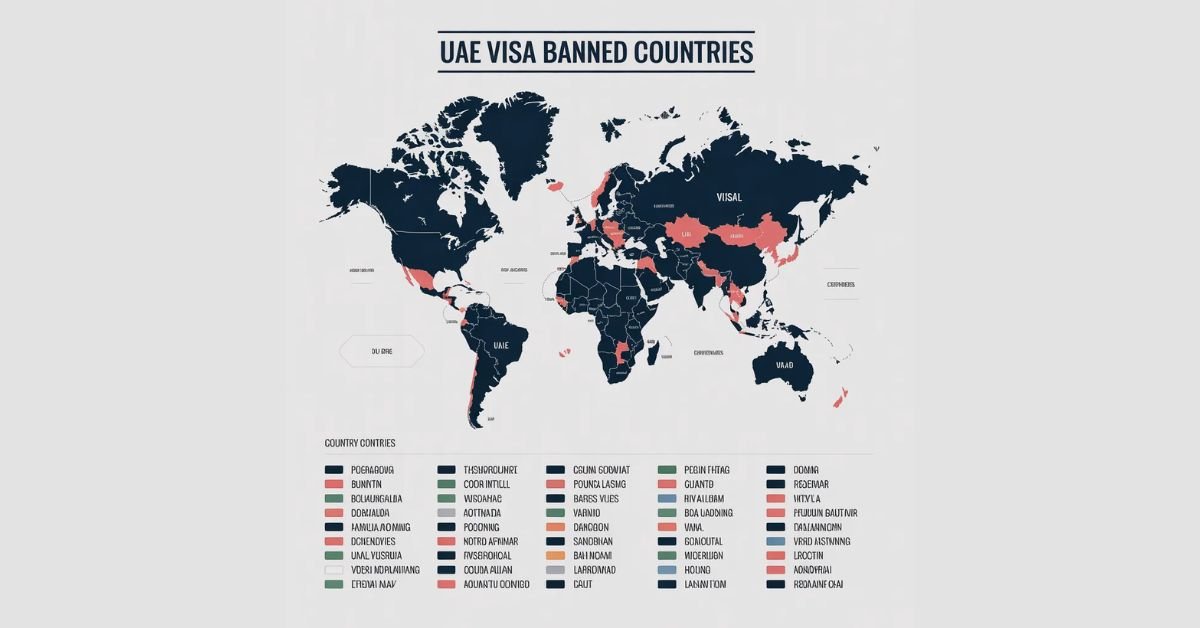
Based on consistent reporting from immigration consultancies across Dubai and Sharjah, embassy-level informal communications, and verified traveler experiences corroborated by regional media since late 2025, nine countries are currently facing either a full suspension of new tourist and work visa applications or dramatically elevated refusal rates. These countries are Afghanistan, Libya, Yemen, Somalia, Lebanon, Bangladesh, Cameroon, Sudan, and Uganda.
The pattern of restrictions reportedly began to emerge between September and October 2025, when immigration consultancies first started flagging consistent tourist and work visa refusals for nationals of these countries. By late 2025, embassy-level informal communications had confirmed processing holds for several of the listed nationalities. By January 2026, reporting intensified, with Bangladeshi workers and Ugandan nationals documenting complete processing stops. As of the time of writing in mid-2026, no official UAE government statement has been issued either confirming or lifting the suspension, and the pattern remains active according to available reports.
It is important to note that the Bangladesh Ambassador to the UAE has called reports of a formal ban “inauthentic,” and Uganda’s UAE envoy has similarly disputed the characterizations. This further underscores that what is being observed is a de facto restriction, not a formally declared policy — which makes it all the more important for travelers to conduct thorough due diligence before making any travel commitments.
Why These Restrictions Are Believed to Exist
The reasons behind the reported restrictions are not uniform across all nine affected countries, but several patterns emerge from available reporting. Security and diplomatic considerations appear to play a role for countries like Afghanistan, Libya, Yemen, and Somalia, all of which have faced protracted instability, conflict, or governance crises. The UAE, as a regional power with complex geopolitical interests, has historically adjusted its visa policies based on bilateral relations and security assessments.
For countries like Bangladesh and Uganda, labor migration concerns and human trafficking risks have been cited as contributing factors. The growing exposure of trafficking networks exploiting migrant workers in the Gulf region — particularly affecting women from sub-Saharan Africa and South Asia — has prompted broader scrutiny of visa issuance for high-risk migration corridors. In Sudan’s case, the country’s ongoing internal conflict and the resulting documentation and verification challenges make processing new applications both difficult and high-risk from an immigration control standpoint.
Lebanon’s inclusion appears tied to a combination of factors including its severe economic collapse, the resulting surge in emigration-driven visa applications, and diplomatic tensions that have fluctuated across the broader region. Cameroon’s situation reflects a pattern of high overstay rates and irregular migration that border authorities and immigration consultancies have flagged over recent years.
Who Is Not Affected: Major Sending Countries Remain Open
One of the most frequently asked questions among the millions of South Asian and Southeast Asian workers and tourists who depend on UAE access is whether countries like India, Pakistan, Nepal, and the Philippines are included in the restrictions. Based on available reporting as of 2026, none of these high-volume sending countries are on the reported restriction list.
Indian nationals, who represent one of the largest expatriate communities in the UAE with figures consistently exceeding 3 million residents, continue to travel and work in the Emirates without nationality-based restrictions. Pakistani nationals can still apply for tourist and work visas, though first-time applicants may face heightened scrutiny and documentation requirements. Nepali and Bangladeshi applicants occupy a more nuanced position — while Nepal is not on the reported list, Bangladesh is, meaning Nepali nationals are unaffected while Bangladeshis face the documented processing challenges described above.
It is equally important to note that existing residents and visa holders from even the affected countries are not being expelled or denied re-entry under the current restrictions. The reported suspension targets new visa applications specifically — primarily new tourist and work permit requests from outside the UAE. Those who already hold valid UAE residence permits, work visas, or active tourist visas continue to live, work, and travel normally.
How the UAE’s Broader Visa System Works
To appreciate the significance of these restrictions, it helps to understand how the UAE’s visa framework is structured under normal circumstances. The UAE operates one of the most expansive and accessible visa systems in the Gulf region, designed deliberately to support its status as a global hub for tourism, commerce, and international talent.
Citizens of GCC member states — Saudi Arabia, Bahrain, Kuwait, Qatar, and Oman — require no visa to enter the UAE, traveling freely on national identification documents. Nationals of dozens of countries including the United States, the United Kingdom, Australia, all EU member states, Japan, South Korea, China, Singapore, Malaysia, and New Zealand are eligible for visa-on-arrival access, typically receiving a 30-day entry permit that can be extended by an additional 10 days. The UAE passport itself ranks among the most powerful travel documents in the world, with UAE nationals enjoying visa-free or visa-on-arrival access to well over 100 destinations globally.
For nationals of countries not covered by visa-on-arrival arrangements, the standard route is an advance online tourist visa application through ICP Smart Services or authorized typing centers. Processing is usually straightforward, with a 30-day or 60-day tourist visa being the most common categories. Longer-term options include the highly sought-after UAE Golden Visa, which provides 5 or 10-year residency for investors, skilled professionals, students, and other qualifying individuals.
How to Check Your Visa Eligibility and Status Officially
Given the volume of misinformation circulating online about UAE visa restrictions — including fabricated lists and unofficial websites claiming to represent government positions — travelers must rely exclusively on verified sources to assess their visa eligibility. The most authoritative resource is the ICP Smart Services portal operated by the Federal Authority for Identity, Citizenship, Customs and Port Security, where travelers can check visa status and application history. The General Directorate of Residency and Foreigners Affairs in Dubai, known as GDRFA, also provides online services for visa inquiries and status verification specific to Dubai Emirate.
Before applying, travelers should also confirm their status through their country’s embassy in the UAE, which may have informal guidance on current processing realities even when no formal announcement has been made. Engaging a licensed UAE immigration consultancy — particularly one based in Dubai or Sharjah with a verifiable physical presence — is another practical step that can help prospective applicants assess their realistic chances before investing money in a visa application that may be declined.
One practical note: passport validity matters significantly. The UAE generally requires that a passport be valid for at least six months from the intended date of entry. Travelers whose passports are approaching expiry should renew them before applying for a UAE visa, as an expired or near-expiry passport is grounds for rejection independent of any nationality-based considerations.
The Risk of Misinformation and Viral Fake Lists
Perhaps the most important thing travelers can do — beyond checking official sources — is exercise sharp skepticism toward viral social media content claiming to provide “official” UAE banned country lists. In September 2025, a list naming nine countries as formally banned circulated widely across social media platforms and was even picked up by major Indian media outlets including The Times of India, MoneyControl, and LiveMint. Investigative follow-up revealed that the original source was an unofficial commercial website that had clearly labeled its own content as based on “unofficial observations” — a disclaimer that was stripped away as the list spread.
The damage caused by such misinformation is real. Travelers who encounter fake lists may either unnecessarily cancel legitimate travel plans or, conversely, dismiss valid warnings because they cannot find “official” confirmation. Neither outcome serves travelers well. The reality — that observable restrictions exist without formal government acknowledgment — is more nuanced than either extreme, and navigating it requires critical information literacy.
What Travelers from Restricted Countries Can Do
For nationals of the nine countries currently facing reported restrictions, the situation is difficult but not without options. First, anyone already holding a valid UAE residence permit or work visa should understand that they are not affected and can continue their status normally. Renewal procedures through standard channels remain available for existing residents.
For those seeking new entry, transit through the UAE without formal admission is a separate question from tourism or employment entry, and rules differ. Travelers whose primary destination is a third country and who are transiting through Dubai International Airport on a short layover may not need a UAE visa at all, depending on their itinerary and passport. However, this should be confirmed with the airline and through official channels before travel, as transit visa rules vary.
For work-related travel, nationals of affected countries may find that employer sponsorship through a well-established UAE company with strong relationships with immigration authorities can sometimes navigate the current climate more effectively than individual applications. This is not a guarantee, but it reflects the reality that institutional relationships and documentation quality play a significant role in outcomes.
Final Thoughts: Stay Informed, Plan Smart
The UAE remains one of the world’s most visited destinations, welcoming tens of millions of tourists, business travelers, and residents annually. Its visa system, at its most functional, is genuinely open and accessible. The current period of reported restrictions for specific nationalities represents a challenging but navigable moment for affected travelers — provided they approach the situation with accurate information, realistic expectations, and a commitment to using official channels.
The key takeaway is this: no official UAE ban list exists in published form, but real-world restrictions are being experienced by nationals of specific countries. The gap between official silence and observable reality is where travelers can get hurt. Staying informed through legitimate sources, checking your visa status through ICP Smart Services, consulting licensed immigration professionals, and avoiding viral misinformation are the most powerful tools available to any traveler navigating the current UAE visa landscape.
