

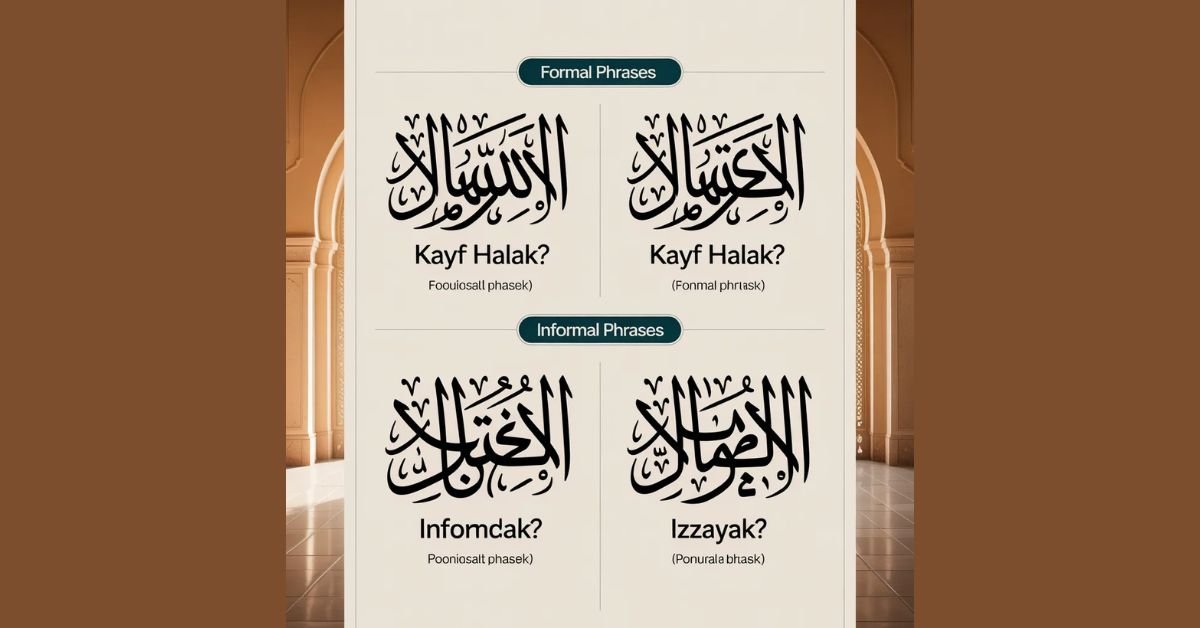
Did you ever pay attention to a greeting in Arabic, said it with confidence, and saw the listener giving you a peculiar look? This usually occurs due to the fact that Arabic is not a mono varied way of speech. Even the manner in which you ask a question like How are you varies according to the context of the interaction where you are either in a formal interaction or even you may be chatting with your friends and also in a certain area. You will find out in this guide How Are You in Arabic, when to use formal or informal words, and how culture influences the conversation in everyday life. At the end, you would be able to know what phrase is best said and why.
Why “How Are You?” Is Different in Arabic
In English, How are you? is applicable pretty much everywhere. Arabic, nonetheless, does have levels of formality and has heavily-anchored culture with regards to greetings. Inquiring about well being of a person is not merely a question, but a respectful and socially mindful delinquency.
More than 420 million citizens of the world speak Arabic, and it is considered to be among the most widespread languages of these days. Whereas Modern Standard Arabic brings the media, education, and writing together, there is excessive dependence on speech forms in everyday conversation. This brings about a difference between what the learners study and what people actually say.
Eastern Standard Arabic and Colloquial Arabic
Modern Standard Arabic (also referred to as MSA) is spoken in news reports, formal speeches, books and in official communications. It is known in Arabic-speaking nations, and therefore it works best in formalities.
Conversely, the variation of the spoken Arabic language is country-wise as well as city-wise. When individuals meet without serious meetings, they hardly use full MSA sentences. They instead use simplified and friendly expressions, which fit the situation.
Being aware of these two styles makes you not sound too formal or too informal.
The Most Popular Formal Phrase
The most agreeable official manner of saying how are you in Arabic is:
Kayfa ḥāluk? for a man
Kayfa ḥālukِ? for a woman
This term is a direct borrowing of Modern Standard Arabic. It is grammatically right and polite and can be used in a professional meeting, interview, teachers, elders or even in a written form.
Kayfa is how and ḥal is condition or state. Collectively, they make up an honorable question concerning the well-being of a person.
Formal Responses in Arabic
When a person formally inquires about your well-being, then the answer will tend to reflect the same. A common answer is:
Ana بخير، الحمد لله
This implies that I am okay, glory to God.
It is culturally acceptable and welcome even in the work environment. It is very humble and positive instead of being religious zealous.
Why Less Formal Greetings Are More
Formal Arabic is an alien in everyday life. Short, casual expressions are often used by friends, colleagues and neighbors. Formal Arabic in informal contexts can be unnatural like talking Shakespearean English in a cafe.
There is close and friendly greetings and this is greatly appreciated in the Arab nations.
The Single Most Popular Informal Phrase
In most Arabic-speaking nations, the most used non-formal phrase is:
Kifak? for a man
Kifik? for a woman
This is a straightforward, informal and easy to comprehend phrase. It is effective with peers, friends and individuals of the same age.
Depending on the region it may sound a little different, but the meaning remains the same. This renders it one of the most secure informal alternatives to learners.
Informal Greetings and their Casual Responses
Informal Arabic responses are usually short and friendly. A typical reply is:
Mniḥ, الحمد لله
This means “Good, thank God.”
In some cases, the communication does not stop at all because greetings are regarded as an introduction and not a complete exchange.
Levantine Arabic Differences
Informal Arabic is spoken in academia in nations such as Jordan, Lebanon, Syria and Palestine. Common variations include:
Shu akhbarak? i.e. What is new with you?
Kif el- h2 Hala? How things are?
These words transcend the health and are open to discussion. Being able to use them is an indicator of cultural sensitivity and fluency in the language.
Gulf Arabic Expressions
Gulf countries have warmer and more expressive greetings. One commonly used phrase is:
Shlonak? for a man
Shlonik? for a woman
This statement is friendly, and in many cases it can be succeeded by other polite phrases. The Gulf culture is very hospitable and welcoming and therefore the greetings can take a longer time than anticipated.
Daily Speech and Egyptian Arabic
Egyptian Arabic is a common language because of the film and television. In Egypt, you will often hear:
Izzayyak? for a man
Izzayyik? for a woman
This is a highly informal term that is mostly applied even to strangers. Egyptians are considered to be friendly and therefore when there is a greetings, it is usually accompanied with jokes or questions.
Moroccan and North African Usage
In Morocco and some regions of North Africa Arabic mixes with the local languages. A common phrase is:
Labas?
Literally this means; Is everything okay?
Even though it is in contrast to the Eastern Arabic, it shares a similar cultural value of verifying the well-being of someone.
Grammar Awareness and Gender
The Arabic greetings usually vary depending on gender. Being a native speaker, it may be clear that the mistakes were made; nevertheless, the situation to use the correct form is a demonstration of respect and hard work. Even the slightest alteration of the pronunciation can help your Arabic sound to seem more natural and assertive.
This difference in gender is a factor that learners might experience hesitation, though with practice, one can soon have a sense of comfort.
Expectations in regards to greetings in culture
The Arabic-speaking cultures do not make a hurry in greetings. When someone poses a question about how you are doing, they will probably respond by pausing, maintaining eye contact and in some cases asking further questions. Omitting this step can be either rude or unfriendly.
The intercultural communication studies have revealed that phrases of relationship building are more important in the Middle East rather than in most of the western cultures. That is why the greetings seem to be more meaningful and longer.
Religion in the Common Language
Such expressions as alhamdulillah are used in everyday speech even when a non-religious speaker is speaking. They show appreciation instead of adhering to strong faith. Having knowledge of this will enable the learners not to misunderstand the common responses.
The appropriate use of such expressions demonstrates cultural fluency as opposed to religious stance.
When to Use Formal vs Informal Arabic
The selection of the right phrase is determined by age, status and the setting. Professional settings, academic debates, and respectful conditions are formal attire in Arabic suits. Slang Arabic is used in social events, friendships and informal purposes.
In the event of confusion, it is always safe to begin more formally. Then the other individual can change his or her style to one that is more relaxed and allow you to do the same.
The pitfalls that learners fall into
The one mistake that is common is to learn a single phrase and apply it to all places. One other one is replying too short, and this can be perceived as dismissive. There are also learners who do not even meet anyone as they are too scared of making some mistakes.
As a matter of fact, there is more to doing than to being perfect. The majority of Arabic speakers will like any person who makes an effort to greet them well.
Learning Greetings: How it Enhances Fluency
Confidence is acquired with Mastery of greetings. It helps you to initiate dialogues, make good impressions and learn to listen. Research on language learning indicates that high-frequency phrases have a higher rate of enhancing fluency than complicated grammar.
One such saying is how are you? It is a phrase that provides entry points in both social and linguistic terms.
Conclusion
To know how to say in Arabic How are you? is much more than translation. It demands the knowledge of formality, culture, gender and regional habits. The formal uses of the Modern Standard Arabic language are the expressions which are used in formal situations as opposed to the everyday use where each variation has its own use. You can respect people by appropriate greeting at the appropriate time, therefore it will enhance rapport and allowing the natural flow of communication. These expressions will be your second language and with practice you will have no problem relating well with the Arabic speakers globally.
